
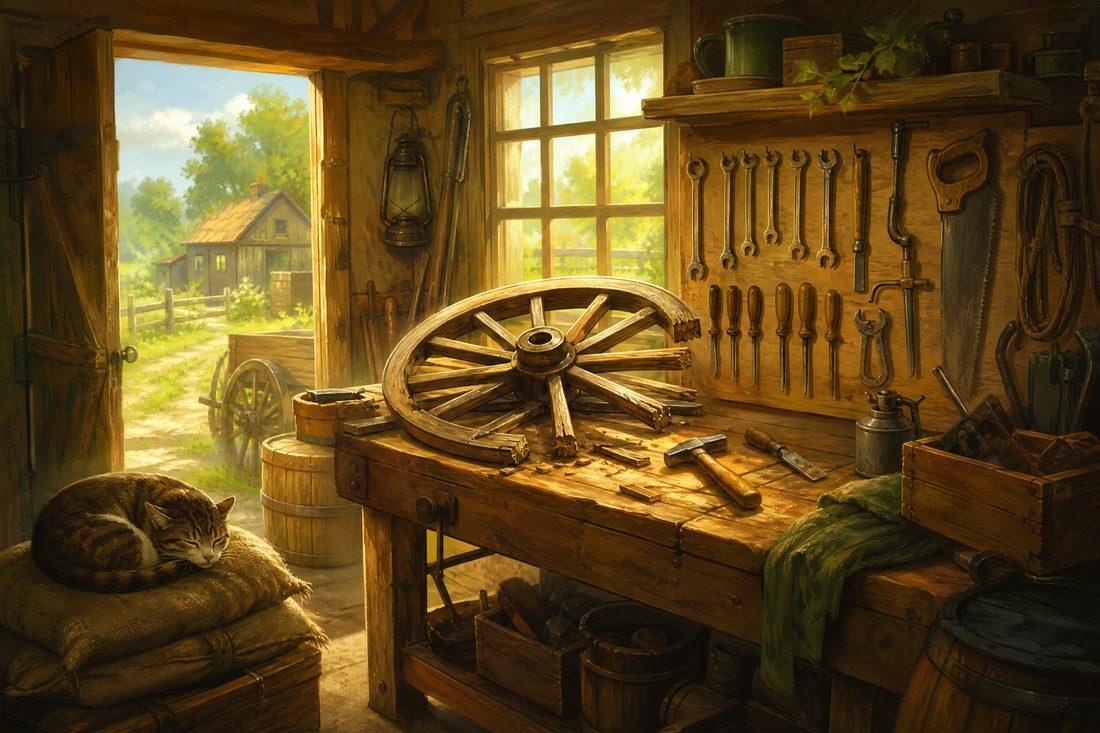
You wake in a workshop. On the bench in front of you is a cart wheel with three broken spokes. On the wall behind the bench, arranged in an order that is not accidental, are a saw, a chisel, a mallet and a length of seasoned wood.
Nothing is said. No panel appears. The camera does not pan to anything. Four minutes later we had repaired the wheel, understood the game's entire crafting logic, and learned three things about the world that no dialogue would have made us believe.
What those four minutes contain
Transcribed onto cards afterwards, the opening turns out to carry fourteen distinct rules. Eleven of them are shown, three are told, and none is repeated.
| Rule | How it arrives |
|---|---|
| Objects have condition states | Shown — the wheel is visibly broken in three places |
| Tools are held one at a time | Shown — taking the saw puts down the mallet |
| Materials must be prepared before use | Shown — raw wood will not fit the socket |
| Work has a correct order | Shown — a spoke cannot seat before the rim is freed |
| Mistakes are reversible | Shown — a badly cut spoke can be recut |
| Tools wear | Shown — the saw visibly dulls across four cuts |
| Where tools live | Shown — the pegboard has outlines |
| Time passes while you work | Shown — the window light shifts |
| Movement and interaction | Told — two small prompts on first launch |
| How to save | Told — one line, once, in the corner |
Why the pegboard is the best single decision
Each tool hangs on the wall over a painted outline of itself. That is the entire inventory tutorial. You learn that things have places, that the places are visible, and that a missing tool is legible at a glance from across the room.
We did not consult the inventory interface once in fifty-two hours, because the workshop wall is the inventory interface, and it works better than any grid would. This is what the shown category means in practice: a rule delivered by a room rather than a sentence.
An opening that explains nothing and teaches everything is not a game without a tutorial. It is a game whose tutorial is made of furniture.
The retention check
At the ten-hour mark we re-tested all fourteen rules cold, without looking anything up. Thirteen were intact. The one that failed was the saving instruction — a told rule, delivered once, in text, at the moment of least attention. That is a small and instructive failure and it repeats across the whole file.
Where the game is weaker
The opening sets a standard the middle of the game does not keep. Around hour twelve a market system arrives and is explained with six panels of text, entirely at odds with everything before it. Two later systems are handled the same way, and each one lands with a thud.
The farming half is also thinner than the repair half. Crops grow, are harvested and are sold, with none of the tactile specificity that makes the workshop remarkable. We spent fifty-two hours here and about forty of them in one building, which the design does not seem to have anticipated.
What other developers should take from it
Not the absence of text, which is a symptom rather than a lesson. The lesson is that a rule is best introduced by a situation in which the player wants to know it, and that arranging such a situation is a level design problem rather than a writing problem.
The broken wheel works because a person who sees a broken thing and a set of tools already wants to fix it. Nothing had to be motivated, so nothing had to be explained.
| Element | Assessment |
|---|---|
| Opening (first 4 minutes) | Best in the file |
| Rules shown vs told | 11 shown, 3 told |
| Retention at ten hours | 13 of 14 intact |
| Mid-game systems | Panels; a clear regression |
| Farming half | Thin beside the repair work |
Where this leaves it
The opening every developer in this genre should study, attached to a game that forgets its own lesson twelve hours later. Worth playing for the workshop alone, and worth studying for four minutes that do more teaching than most games manage in two hours.