
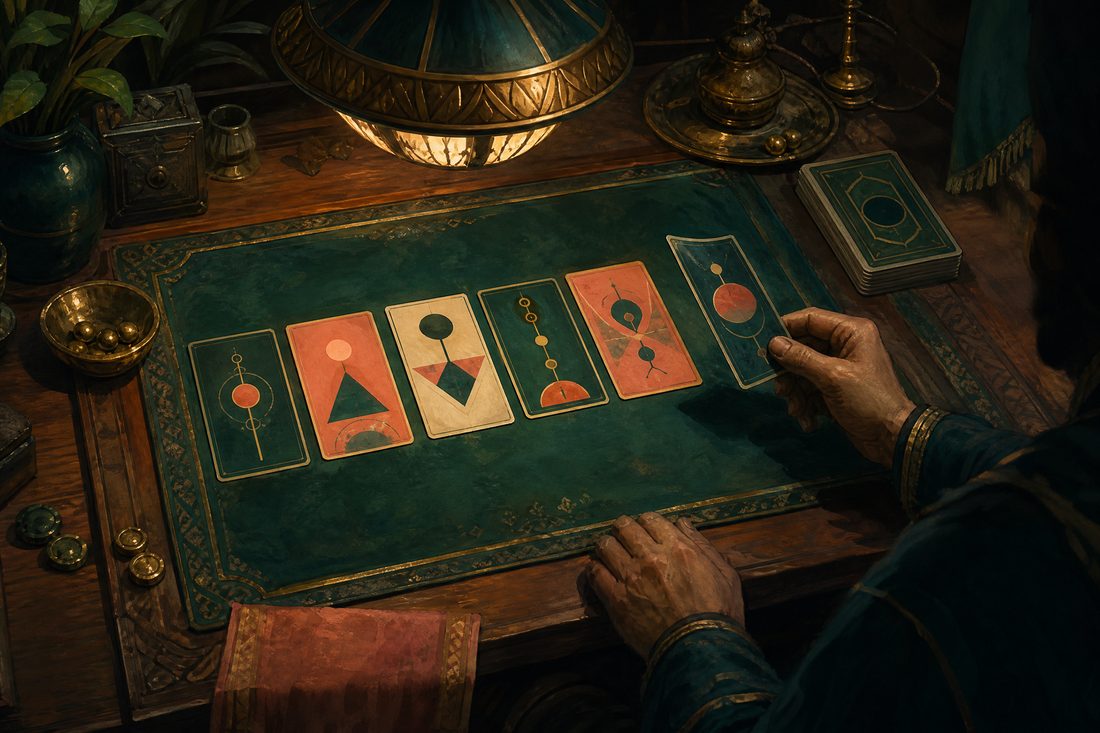
The card game inside this is clever. Cards have two values that trade against each other, so a strong card is expensive to play and a weak one accelerates you, and the deck you assemble by hour ten is genuinely yours. We enjoyed thirty-eight hours of it.
Getting to the point where any of that was visible took two hours and eleven minutes, and we timed every one of them.
The anatomy of a two-hour tutorial
| Segment | Duration | Content |
|---|---|---|
| Opening narration | 6 min | Non-interactive; story framing |
| Scripted hands 1–4 | 28 min | Every card play dictated |
| Rules panels, first block | 14 min | 17 panels, dismissed individually |
| Scripted hands 5–8 | 34 min | Two mechanics that do not appear again for hours |
| Rules panels, second block | 19 min | 26 panels, several restating the first block |
| Scripted hands 9–11 | 21 min | Advanced interactions, still dictated |
| First free hand | — | At 2h 02m |
| Competence | — | At 2h 11m |
What the cards revealed when we laid them out
Transcribed, this opening contains twenty-nine distinct rules. Nine of them are stated more than once, four are stated three times, and six describe mechanics that do not become available until somewhere past hour four.
Laid out in sequence on the table, the redundancy is impossible to miss. Two panels twenty minutes apart say the same thing in different words, and neither is the moment at which a player needs it.
No permitted mistakes
The most damaging decision here, and the least visible. Across all eleven scripted hands, every card you play is chosen for you: an incorrect play is simply refused, with a panel explaining why.
The consequence is that you arrive at the first free hand having never made a decision, never lost anything, and never discovered what a bad play feels like. The game has told you what is good. It has not let you find out what is bad, which is the only half of the lesson that sticks.
A tutorial that never lets you lose has taught you its vocabulary and none of its judgement. The first real defeat then arrives as a surprise rather than as a lesson.
The retention check
At ten hours we tested all twenty-nine rules cold. Eleven were intact, eighteen were not, and of the six rules describing systems unavailable during the tutorial, none survived at all.
This is the clearest evidence in the file for a simple claim: a rule explained before it can be used is not learned, however clearly it is written. Quarter Deck's panels are well written. Sixty per cent of them were wasted.
The twelve-minute version
We reconstructed what this opening would need if it introduced only what the first free hand requires: the two card values, the trade between them, the discard rule, and how a turn ends. Four rules. Played rather than read, with mistakes permitted, that is about twelve minutes of work.
Everything else in those two hours could have arrived at the moment it became relevant, which is what the game does correctly with its final two mechanics — both introduced late, in one line each, and both retained perfectly at the ten-hour check.
The game underneath
Worth the trouble, which is why this scores as well as it does. The economy is tight, the twenty-two card archetypes genuinely differ, and there is a mid-game run of encounters that forces you to dismantle a deck you have grown attached to, which is the best thing in it.
The presentation is lovely and the audio restrained. Our remaining complaints are small: too much repetition in the encounter pool by hour thirty, and an endgame that resolves the difficulty curve downward rather than upward.
| Element | Assessment |
|---|---|
| Opening length | 2h 11m; longest in the file |
| Rules stated | 29, of which 9 repeated |
| Retention at ten hours | 11 of 29 |
| Mistakes permitted | None in 11 scripted hands |
| Card game itself | Clever, tight, worth playing |
Where this leaves it
A recommendation with a warning about the first evening. The design underneath is strong and the opening is an act of fear rather than of teaching — it explains everything twice because it does not trust the player to be wrong once, and that mistrust costs it two hours and most of its own instruction.