
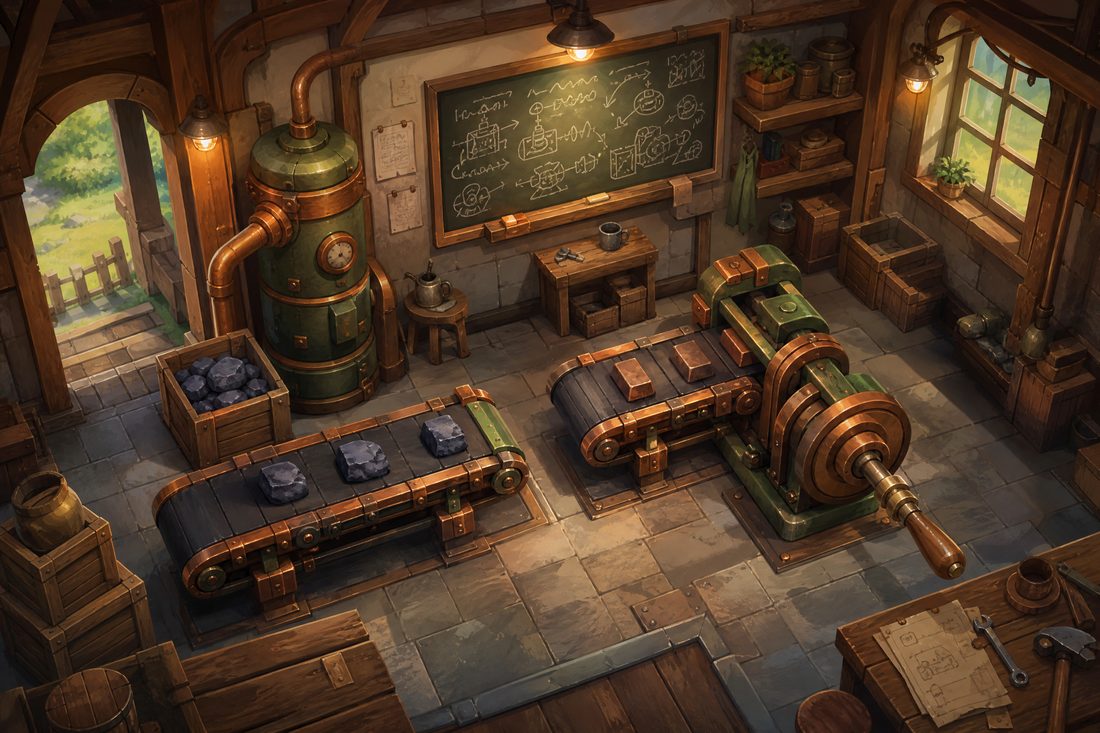
Automation games have the hardest onboarding problem in the medium. Their pleasure is second-order — the satisfaction of a system that works without you — and second-order pleasure cannot be demonstrated in a first minute.
Most of the genre responds by explaining. This one responds by making you do the job by hand until you resent it.
The six minutes
The opening task is to fill a crate with crushed ore. The only crusher available is hand-cranked: you hold a key, the wheel turns, one piece is crushed, and the crate needs about forty pieces.
It takes roughly six minutes. It is dull. Around the four-minute mark we started looking around the room for a better option, which is precisely the behaviour the design wants, and on a shelf behind us was a small motor and a belt.
Nothing had suggested we look. Nothing had explained what the motor was. We wanted it because we had spent four minutes earning the desire.
The most reliable way to teach why a system matters is to withhold it just long enough for the player to invent the need themselves.
What the opening contains
| Segment | Duration | How rules arrive |
|---|---|---|
| Hand crushing | 6 min | Shown — the problem, felt directly |
| Finding the motor | 3 min | Discovered — no prompt of any kind |
| First belt built | 7 min | Shown — placement rules by trial |
| Power runs out | 4 min | Shown — the failure teaches fuel |
| Second machine chained | 8 min | Shown — throughput mismatch is visible |
| Interface and saving | 3 min | Told — four prompts, once each |
Twenty-two rules, of which eighteen are shown or discovered. Only the interface conventions are stated, which is the correct division: a keybinding is arbitrary and must be told, while a throughput mismatch is a fact about the world and can be seen.
Letting the first build be wrong
Our first belt layout was bad. It fed a machine faster than the machine could process, ore backed up, and the line stalled. Nothing warned us and nothing corrected it.
That stall is the second great teaching moment. Throughput matching is the central skill in this genre and the hardest thing to explain in words; here it is a pile of ore sitting on a belt, visible from across the room, and it took us about ninety seconds to understand it without assistance.
The retention check
Twenty of twenty-two rules intact at ten hours. The two failures were both told rules — a keybinding for the overview map and the existence of a blueprint copy function, neither of which we had used in the interval.
Every shown and discovered rule survived, which is now consistent across the whole file and is the finding this publication is most confident about.
Where it costs the player
Six minutes of deliberate tedium is a real gamble and it will lose some players. We would defend it, but not without acknowledging that a person browsing a refund window at minute five has been handed a reason.
There is also a discoverability risk in the motor: it is on a shelf, unlit, unremarked. We found it because we were looking for something. A less curious player might crank out three crates before noticing, and the design has no fallback for that.
The rest of the game
Excellent, and the longest thing in this file at seventy-one hours. The mid-game logistics puzzle around a river crossing is the best set piece we have played this year, and the research tree resists the usual problem of making earlier machines obsolete — the hand crank remains genuinely useful in a corner case forty hours later, which is a lovely piece of design discipline.
Complaints are modest: the late-game interface strains under large factories, and the endgame objective is arbitrary in a way the rest of the design is not.
| Element | Assessment |
|---|---|
| Opening (31 minutes) | Best-argued in the file |
| Rules shown or discovered | 18 of 22 |
| Retention at ten hours | 20 of 22 |
| Risk of losing players early | Real and unmitigated |
| Game overall | Seventy-one hours, few regrets |
Where this leaves it
The highest score this publication has given, for a game whose opening is willing to be briefly unpleasant in order to be permanently understood. Every automation game should study those six minutes, and every one of them should also notice that the motor on the shelf needed one more grain of visibility.